Sunday, June 27, 2010

SUKMA XIII 2010

SUKMA (Sukan Malaysia) XIII held in Melaka has proven to be the best for some states, but disappointing for others. As far as bowling is concerned, it has proven to be the best for Sarawak. With a total haul of 7 gold, 3 silver and 2 bronze medals, they have surpassed their official goal of 4 gold medals. Wilayah Persekutuan gave them a good fight by amassing 4 gold medals, 5 silver medals and 1 bronze medal.

What this year’s results show is a far cry from past SUKMAs when powerhouses like Selangor, Penang and even Sabah, dominated most of the medals on offer. What went wrong? I suppose it’s back to the drawing board for some states to dissect their performance.

Having said that, the youths who dominated this year’s tournament have proven their worth. The majority of them are either in the country’s national backup squad or national youths.

 Victorious Sarawak Boys

Victorious Wilayah Persekutuan Girls

The Masters Finals for both the Boys and Girls categories were thrilling to watch. With a final push for the last two medals on offer, it was a ‘now or never’ attitude for all concerned. It turned out to be Wilayah Persekutuan’s day. They captured both the gold medals, although it wasn’t smooth sailing at any moment of time.

In the Girls category, eventual champion Nur Umirah of Wilayah Persekutuan had to fight her way up as 5th seed. In the quarterfinals, she defeated Sarawak’s Jacqueline Sijore with games of 257-194 and 226-184 to set up a match with Siti Shazwani of Johore. With games of 211-184 and 213-168, Umirah emerged victorious. In the Finals, Penang’s Fatin Syazliana was no push over. Fatin bowled games of 212/202/175, but Nur Umirah replied with games of 165/245/259 to win her first SUKMA gold medal.

In the Boys category, top seed Syimir Abdul Razak of Wilayah Persekutuan had a close call with 5th seed Muhd Aizudeen of Selangor breathing down his neck. Syimir had earlier disposed off Dinie Faliq of Melaka with games of 239-183 and 258-222 at the quarterfinals. Aizudeen won the first game on 256-232 only to lose the second game on 189-257. Forcing a third game decider, underdog Aizudeen had finished on a 236 game. He could only wait to see if Syimir could do the impossible by striking home to beat him by 1 pin. Being the more experienced of the two, this National Youth proved he is no fluke…he finished on a 237 game to set up a final match with 2nd seed Jonathan Ding. What ensued was a thrilling match…with Syimir and Jonathan matching each other frame for frame. Syimir lost game1 on 198-202. He made up with a win in game2 with 246-179. The finale was a repeat of his match with Aizudeen…he won by 1 pin on a 259-258 game.

From Sir Jonathan
ABC To Bowling
Thursday, June 10, 2010

There You Go..


Refer to last posted an article on The Perfect Strike a year ago (2009/02/22) from Sir Jonathan ABC To Bowling. He believe what he have for you today will benefit many bowlers who always lament leaving pin 10 standing.

LEAVING THE 10 PIN: A Close Examination
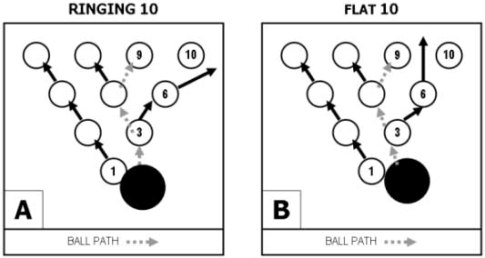
Most of the time when a good shot is thrown into the pocket, we anticipate a strike. This does not always happen. Your first thought could be you were just unlucky. Let me tell you this…luck has very little to do with it. The two diagrams I’ve drawn for you will explain exactly what has actually taken place.


You are looking at the ball hitting the pocket at a 60-ft distance. The ball could have struck the head pin slightly heavy (diagram A) or it could have struck the head pin slightly light (diagram B). Of course there’s always the question of the ball’s angle of entry to consider.

 2nd prize
Tournament with Full Time Businessman Group
29 May 2010 at ABS Bowl South City

Thursday, May 20, 2010

Lenggang Lenggok..

Salam semua, n3 kali ni takda jiwang-jiwang, cintan-cintan ok hehe..n3 kali ni serius sikit, nak cakap pasal bowling..pagi ni, aku dapat email dari Sir Jonathan ABC to Bowling mengenai 2 cara pergerakan badan atau "Two Step Drill" dalam bahasa bowlingnya..pergerakan ini perlu dipratikkan semasa melontarkan bola bowling kesayangan anda nanti ye..

Banyak juga silap yang aku buat, kadang-kadang sengaja buat silap sebab da malas, mana taknya, da masuk game ke 4 game ke 5, tangan pun da naik biru masa tu hehe..takpe-takpe, kali ni aku nak syer sikit cara lenggang lenggok waktu nak melontar..

Sebelum tu, Sir Jonathan emailkan pada aku dalam english, mula-mula aku nak alih bahasakan ke bahasa venezuela agar kita semua mudah faham tapi rasanya lagi mudah dalam english..korang tanya je kalau tak faham tau..

- Accelerated Power Step -
The two-step drill is an integral part of a bowler’s bio-mechanical functions in the process of developing the power step. Besides acquiring good swing timing, the two-step drill also acts as a catalyst to developing an accelerated swing…a knowledge that is so advantageous in today’s modern power play.

HOW TO PRACTICE THE TWO-STEP DRILL 

  • Start by positioning yourself about 4-5 feet from the foul line.
  • Place your feet in the staggered starting stance, with the take-off foot (right leg for right handed bowler) about 3-4” further back.
  • Hold ball stationary by the side of the body. Extend balance arm to 8-9 o’clock.
  • Begin by pushing the ball forward. During the backward downswing, take a small step forward with the take-off leg.
  • When the ball reaches the apex of the backswing, you should be in the set ‘pro’ posture and your body weight should be centered on your take-off leg.
  • NOW you are in the power zone. With your take-off leg, push forward strongly to drive into the slide with your sliding leg…as you accelerate the forward swing.
  • The result will be a higher ball speed with higher rev rates.
  • Practice this drill until you achieve the desired results.

Monday, April 26, 2010

Bowling Style

Unusual Bowling Style 1


A look at varying style of bowling, from competitors at the 2007 Tenpin Bowling Association Women World

Thursday, April 22, 2010

2009 Geico PBA Team Shout Out..

Bowling Terms, Lingo and Definitions..

Knowing proper bowling terms can help you when you are at the alley.

In order to be the best bowler you can be, it is important to know all the bowling terms and lingo. Bowling has its own unique words and definitions. Here are all the bowling terms and words you need to know.

Bowling Terms:

  • Address: Bowler’s starting position.
  • Alley: playing surface, made of maple, pine or urethane boards; urethane lanes are becoming more popular than wood
  • All the way: Finishing a game with nothing but strikes.
  • Anchor: The last person to roll in a team competition.
  • Angle: The direction in which the ball travels when going into the 1-3 pocket, 1-2 for left hand bowlers.
  • Approach: Part of the lane from the back of the ball return area to the foul line.
  • Arm swing: The arc of the bowling arm and hand from the first move toward the line until the delivery of the ball over the line.
  • Baby ball: To throw too delicate or release too carefully.
  • Back ends: The last 6 feet of the lane.
  • Backup: A ball that falls to the right for right-hand bowlers and left for left-hand bowlers.
  • Balk: To interfere or cause another bowler to stop or not complete in their normal actions.
  • Ball rack: the rack used to store house balls or where the ball return rests balls before a turn.
  • Ball return: Track between the lanes the ball rolls on when being returned to the rack.
  • Balsa: A powerless hit on the headpin.
  • Bedposts: A 7-10 split.
  • Belly the ball: Increase the width of a hook from an inside starting point.
  • Bench work: Conversation or actions meant to upset an opponent.
  • Bender: Hook or curve shot that comes close to the channel before breaking into the pocket.
  • Big fill: Nine or ten pins on a spare, or double on a strike.
  • Big five: Spare of three on one side and two on the other.
  • Blind: Score allowed for an absent member
  • Blow: A missed spare.
  • Blow a rack: A solid strike.
  • Blowout: Downing all the pins but one.
  • Box: A single frame. .
  • Break: A lucky shot.
  • Bucket: Four-pin diamond on the sides or the center of the lane.
  • Buzzard: Three open frames in a row.
  • Carry: Ability of the ball to knock down pins.
  • Chicken wing: When a bowler’s elbow gets away from his body during a swing.
  • Choke: Failure to accomplish objective.
  • Chop: Chopping the front pin of a spare while a pin behind or to the left or right remains.
  • Clutch: A pressure situation.
  • Come up: Hook in the pocket caused by a spin on the axis.
  • Conversion: Knocking down all the pins that remain with your second ball.
  • Crawler: A strike made by missing the head pin.
  • Curtain: missing in a final frame when a spare would have won.
  • Curve: Ball that breaks from right to left.
  • Cutter: A hook that slices the pins down.
  • Deflection: The ball when it comes into contact with pins and then angles away to the right or left.
  • Delivery: Preparation, Release and Follow-through.
  • Deuce: A 200 average.
  • Dive: A ball that hooks at the last second.
  • Double: Two strikes in a row.
  • Double wood: when one pin is directly behind the other.
  • Dump the ball: Releasing the ball without bending of the knee.
  • Dutch 200: A 200 game scored alternating strikes and spares.
  • Fence posts: A 7-10 split.
  • Fit split: A split where it is possible for the ball to hit both pins.
  • Five-bagger: Five strikes in a row.
  • Flat ball: unproductive ball
  • Follow-through: The motion after release. Should
  • Foul: Touching or going beyond the foul line.
  • Foul line: The mark that determines the beginning of the lane.
  • Foundation: A strike in the ninth frame.
  • Grab: The friction between the lane and the ball.
  • Grandma¹s teeth: An array of pins left standing.
  • Graveyards: Low score lanes.
  • Gutter: Drop offs about 10 inches wide to the right and the left of the lane to guide the ball to the pit.
  • Gutter ball: A ball that goes into the gutter. .
  • Half hit: Between a full and light hit.
  • Handicap: Pins awarded to weak players or teams in an attempt to even out the game.
  • Head pin: Front pin of a rack.
  • Higher: More to the left or right.
  • Home alley: Favorite lane for individuals or a team.
  • Honey: A good ball.
  • Hook: A ball that breaks to the left or right.
  • House ball: Bowling balls provided by the alley.
  • Inside: A starting point near the center of the lane.
  • Jam: Force the ball high inside the pocket.
  • Kegler: A bowler.
  • Kickoff: Smooth ball delivery.
  • Kingpin: The headpin or the number 5 pin.
  • Kitty: Money from team members for misses, and other set fines.
  • Late 10: When the 10 pin hesitates and is the last to go down on a strike.
  • Leadoff man: First manto bowl in a team game.
  • Light seven: A hit too light on either side of the head pin.
  • Line: The path a bowling ball takes.
  • Lofting: Throwing the ball onto the lane rather than rolling it.
  • Logs: Very heavy pins, used for practice.
  • Looper: An extra-wide hook ball.
  • Loose hit: A light pocket hit.
  • Love tap: A tap from a moving pin which knocks it down.
  • Match play: A portion of a tournament where bowlers are pitted against each other.
  • Messenger: A pin that comes across the lane after all the others have fallen down.
  • Miss: A missed spare.
  • Mixer: A ball that causes pins to bounce around.
  • Moat: A nickname for the gutter.
  • Move in: To start from the center of the approach.
  • Move out: To start from a corner position on the approach.
  • Nose hit: To hit the pins dead center.
  • On the nose: To hit to the headpin dead center.
  • Open bowling: Non-league plays for fun or practice opposite league nights.
  • Out of bounds: Area on the lanes where a ball won't make it to the pocket.
  • Outside: Corner position of playing lanes.
  • Over-turn: To apply too much spin to the ball.
  • Par: A game score of 200.
  • Pinching the ball: To grip the ball too hard.
  • Pin deck: Area 60' from the foul line.
  • Pit: Space at end of lane where ball and pins end up.
  • Pitch: Angle in which holes in bowling ball are drilled.
  • Platform: The parts of the lane from the very back of the ball return area up to the foul line.
  • Point Shot: Starting from the first arrow and throwing over first arrow.
  • Position rounds: Parts of a league schedule which call for teams.
  • Pot game: Competition in which two bowlers place a stake.
  • Powerhouse: A strong ball that strikes.
  • Puddle: A gutter ball.
  • Railroad: A wide open split.
  • Rap: When a single pin remains on a good hit.
  • Rat club: A team that shoots low scores for one game.
  • Release: The hand motion as ball is rolled onto a lane.
  • Reset: Resetting the pins.
  • Return: The track which balls roll from pit to the rack.
  • Revolutions: The number of turns a ball takes when rolling from release to pins.
  • Rotation: The spin to the ball at the moment of delivery.
  • Runway: Starting area.
  • Sanctioned: Competition in accordance with American Bowling Congress and Women¹s International Bowling Congress rules.
  • Sand bager: A bowler who keeps his average down in order to receive a higher handicap.
  • Scenic route: The path taken by a sharp curve ball.
  • Separation: The distance you allow between your standing position and where you want the ball to go.
  • Shadow ball: A ball rolled in practice without any pins set.
  • Shotgun: Rolling a ball from the hip.
  • Six pack: Six strikes in a row.
  • Slide: The last step of delivery.
  • Snow plow: A ball that clears all the pins.
  • Spare: All pins knocked down with two balls.
  • Spare leave: Pins standing after the first ball is rolled.
  • Spiller: A light-hit strike.
  • Splasher: A strike where the pins are knocked down quickly.
  • Splice: An area of lane where maple and pine boards join.
  • Split: A spare leave in which the headpin is down.
  • Spot bowling: Target on lane at which the bowler can aim.
  • Steal: To get more pins than you deserve on a strike.
  • Strike: All ten pins go down.
  • Strike out: To get all three strikes in the tenth frame.
  • String: Three or more strikes in a row.
  • Stroke: The arm and hand motion during delivery over the foul line.
  • Sweepstakes: A bowling tournament.
  • Swiss cheese ball: A ball used in pro shops to establish a bowler's finger size and span for drilling.
  • Tandem: Two pins one behind the other.
  • Tap: When a pin stays standing on a perfect strike.
  • Team captain: A lead team member responsible for all members being present, arranging a substitute, and determining team lineup.
  • 300 game: A perfect game of 12 strikes in a row.
  • Three quarter bucket: Three of the four pins of the bucket.
  • Throwing rocks: Racking up strikes with multiple speed balls.
  • Tickler: When the 6-pin gently topples the 10-pin.
  • Track: Area most used on lane
  • Tripped 4: When the 2 pin takes out the 4 pin.
  • Tumbler: A strike where the pins appear to fall individually.
  • Turkey: Three strikes in a row.
  • Venting: Drilling a small hole into a bowling ball to relieve suction on the thumb hole.
  • Wrist master: One of the many accessories worn by bowlers to help keep a firm wrist during back swing.
  • X: Symbol for strike.
  • Yank shot: When a bowler hangs onto the ball too long.
  • Zero in: Find the right strike spot on a lane.
  • /: Symbol for a spare.


Sumber dipetik dari : 2010 helpwithbowling.com

Monday, April 19, 2010

List of Bowling Centres at Selangor

  • A-Bess Bowling Centre South City (03-89481888)  
  • Ampang Superbowl @ Ampang Point (03-42527575)
  • Ampang Superbowl @ Flamingo ( 03-42577082)
  • Ampang Superbowl @ Kajang (03-87393333)
  • Ampang Superbowl @ Klang (03-33445126)
  • Ampang Superbowl @ Puchong (03-58820018)
  • Ampang Superbowl @ Subang USJ (03-80248898)
  • Banting Superbowl (03-3441198)
  • Berunting Strikes Bowl (03-6081888)
  • Megalanes Shah Alam (03-50310288)
  • Perangsang Templer Golf & Country Club (03-9610022)
  • Pins & Balls (03-7338788)
  • Pin Junction (03-77254528)
  • Pyramid Mega Lanes (03-74926307)
  • Selayang Bowl (03-6167945)
  • Sungei Long Golf & Country Club (03-8373733)
  • Tropicana Golf & Country Club (03-7048888)
  • U-Bowl Center (03-77256399)
  • Wonder Bowl (03-9425010)
  • senarai akan dikemaskini dari semasa ke semasa

Template by:
Free Blog Templates